This article refers to the following FIFA regulations:
- Articles 4–9 of the FIFA Football Agent Regulations
Table of contents
- Introduction
- Information for each exam cycle
- The licensing process at a glance
- Meeting the eligibility requirements
- Creating an account on the FIFA agent platform
- Submitting an application and booking the exam
- Changing or withdrawing a booking
- Preparing with the official study materials
- Joining the session and completing the pre-exam checks
- Taking the FIFA football agent exam
- Paying the licence fee and obtaining the licence
Introduction
Under the FIFA Football Agent Regulations (FFAR), individuals must obtain a FIFA licence before providing football agent services.
As a general rule, individuals wishing to become football agents must pass the FIFA football agent exam, an annual examination organised by FIFA to assess knowledge of the regulations and other materials governing the international football transfer system.
No formal educational or professional qualifications are required to apply, although an individual’s profession or experience does not exempt them from licensing or the exam. An exception may apply through the National Law Path. The former Legacy Path, which allowed individuals previously licensed under the FIFA Players’ Agent Regulations to apply without the exam subject to eligibility and application requirements, closed to applications on 30 September 2023.
Information for each exam cycle
FIFA will publish detailed information for each FIFA football agent exam cycle in due time on Inside FIFA and the FIFA agent platform. This will include the circular, study materials and guidance on examination procedures, technical requirements and technical issues, medical accommodation requests, and results and review processes. Candidates should consult the information issued for the relevant cycle for these details and any further questions about the study materials or exam arrangements.
The licensing process at a glance
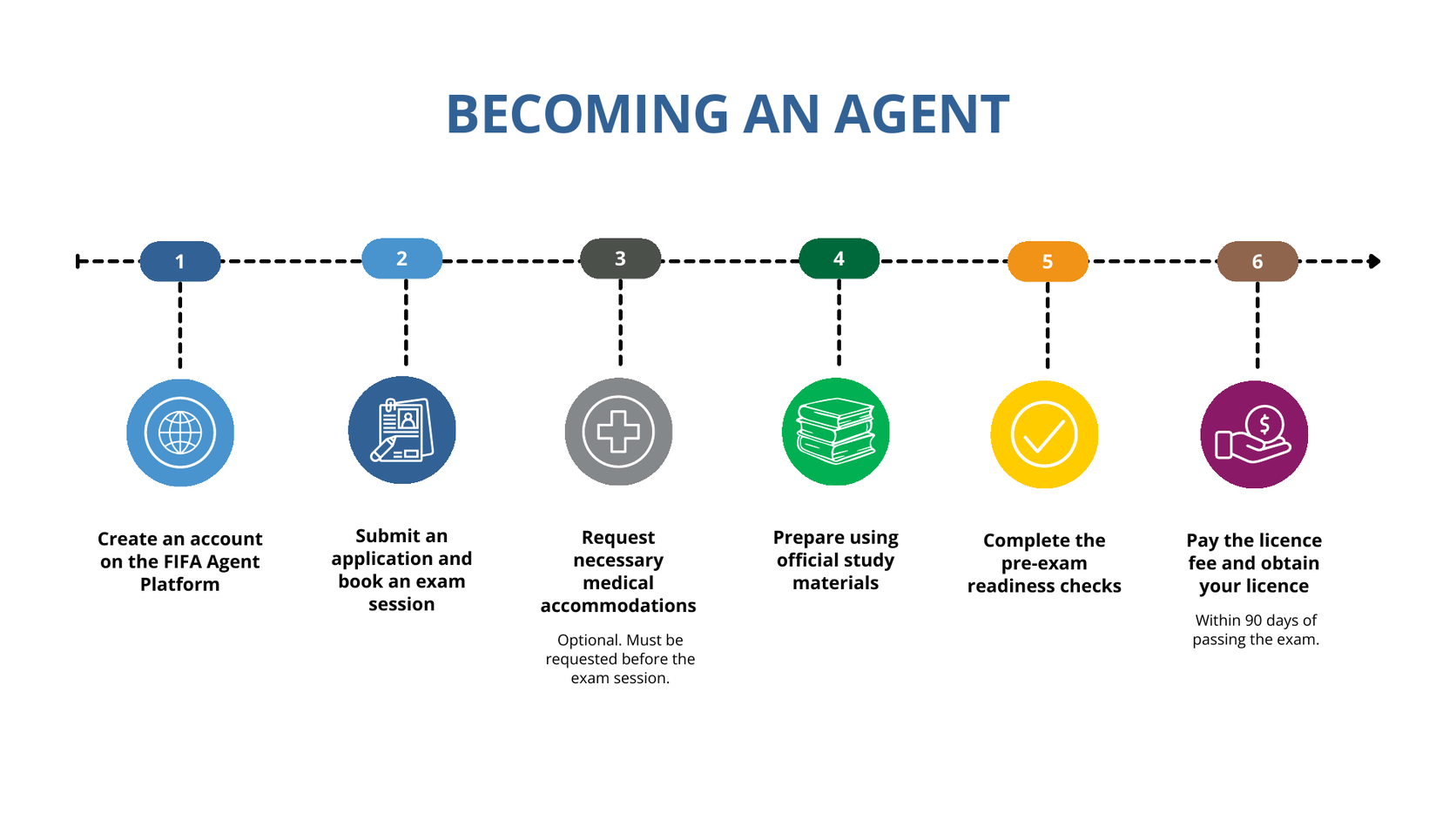
The main steps to obtain a FIFA licence through the exam are to meet the eligibility requirements, create an account, submit an application and book the exam, pass the exam, and pay the licence fee. The sections below explain each step.
Meeting the eligibility requirements
Individuals must satisfy the eligibility requirements throughout the licence application process and licence period; these cover application accuracy, integrity, roles and interests within football, unlicensed activity, bankruptcy and interests in sports betting.
Individuals must:
- Have made no false, misleading or incomplete statements in their application.
- Never have been convicted of a criminal charge, including any related settlements, regarding matters related to organised crime, drug trafficking, corruption, bribery, money laundering, tax evasion, fraud, match manipulation, misappropriation of funds, conversion, breach of fiduciary duty, forgery, legal malpractice, sexual abuse, violent crimes, harassment, exploitation or child or vulnerable young adult trafficking.
- Never have been suspended for two years or more, disqualified or struck off by a regulatory authority or sports governing body for breaches of ethics or professional conduct rules.
- Not be an official or employee of FIFA, a confederation, a member association, a league, a club, a body representing clubs or leagues, or an organisation connected directly or indirectly with them. The exception concerns appointment or election to a FIFA, confederation or member association body to represent football agents.
- Not hold a prohibited interest in a club, academy, league or single-entity league, either personally or through an agency.
- Not have been found performing football agent services without a licence during the 24 months preceding the application.
- Not have declared or been declared personally bankrupt, or held a majority shareholding, directorship or key office in a business entering bankruptcy, administration or liquidation, in the five years before applying or subsequently.
- Not have held an interest in an entity that brokers, arranges or conducts sports betting in the 12 months before applying or subsequently.
The FIFA general secretariat may investigate eligibility at any stage, and individuals must cooperate with requests for documents or information, including translations into English, French or Spanish when requested. Failure to meet the eligibility requirements prevents admission to the exam and results in rejection of the application.
Continued eligibility is one of the ongoing conditions for holding a licence.
Creating an account on the FIFA agent platform
Applications to sit the FIFA football agent exam must be submitted through the FIFA agent platform.
Creating an account requires a valid government-issued photo identification document, with the account details matching those on the document.
The platform verifies identity during account creation by capturing an image of the candidate and comparing its biometric data with the identification document. Candidates must retain the original document for the pre-exam identity check.
Individuals should use an email address they can access and check regularly for FIFA communications. Requests to change the account’s email address are limited to the support period communicated by FIFA.
Technical issues when creating an account on or accessing the FIFA agent platform should be reported to legal.digital.support@fifa.org to open a support ticket.
Submitting an application and booking the exam
Applications to sit the FIFA football agent exam are accepted only during the annual application window, with deadlines listed in local time in Zurich, Switzerland. Individuals who miss the deadline must wait until the next window.
To apply, select “Football Agent licence (Exam path)” on the FIFA agent platform. If this option is greyed out, the application window is closed. Candidates must wait for FIFA to announce the next application window.
For each exam cycle, FIFA publishes a circular setting out the application period, exam dates, applicable rules and conditions, and other administrative information.
Candidates select their preferred exam time slot and language (English, French, German or Spanish) when booking a session. Before submitting the application, they must pay the exam fee in accordance with the amount, method and deadline communicated on the FIFA agent platform and Inside FIFA. This fee helps cover the costs of organising and conducting the exam and is separate from the licence fee paid after passing. Member associations may not charge a fee for the FIFA exam.
Candidates must monitor their application and FIFA communications for requests for information, as booking an exam session does not waive the eligibility requirements or pre-exam checks. Member associations help verify eligibility but no longer organise local exam venues or logistics.
Changing or withdrawing a booking
Candidates may request a change to their exam language, location or time slot within the same exam day by selecting “Request a Change” on the exam booking platform and completing the form before the deadline. The exam day cannot be changed.
Candidates may withdraw through the “Licence application” tab on the FIFA agent platform by selecting “Withdraw licence application”. A withdrawn application cannot be reinstated.
An exam-fee refund requires withdrawal of the application within the refund deadline shown on the platform. A rejected application does not qualify for a refund, even within that period, and the exam fee cannot be carried forward to another edition.
Preparing with the official study materials
FIFA provides the study materials for each exam edition through the FIFA agent platform. The study materials list the FFAR, Regulations on the Status and Transfer of Players, FIFA Clearing House Regulations, FIFA Statutes, FIFA Code of Ethics and FIFA Disciplinary Code, alongside safeguarding and ethical recruitment materials. FIFA may add further materials, so the published pack for the relevant edition determines the applicable study materials and this list is not exhaustive.
FIFA does not organise or endorse preparation courses and does not provide a mock exam to test regulatory knowledge.
The study materials provided by FIFA will also be available to candidates within the exam platform during the examination.
Joining the session and completing the pre-exam checks
Before a candidate starts the exam, invigilators must verify their identity, room and equipment.
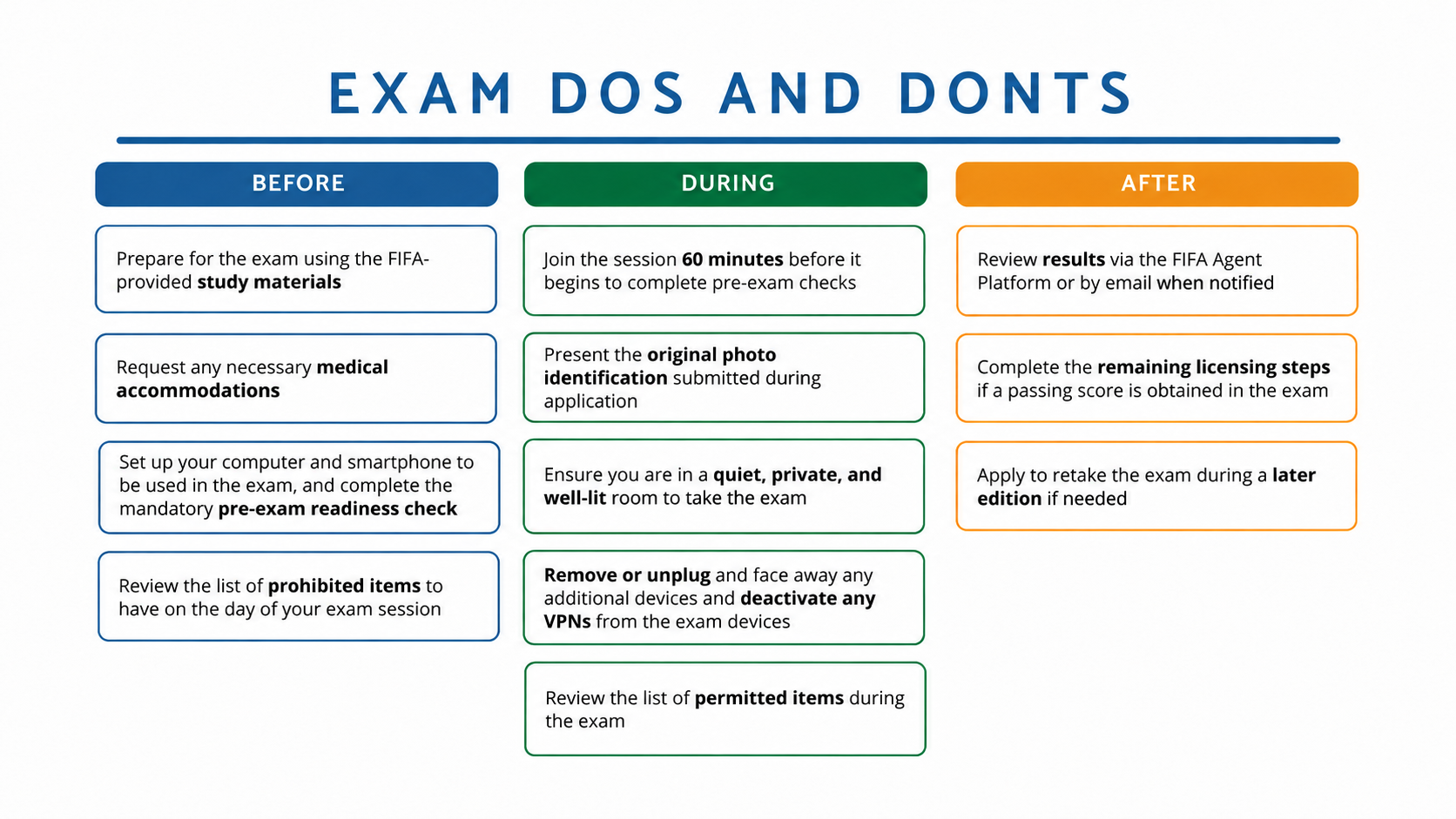
Candidates must present the original photo identification document used for their licence application during the pre-exam check; a photograph or copy is insufficient. If the document has expired or uses non-Roman characters, a secondary valid government-issued photo identification document is required. The invigilator checks these documents before the exam, and failure to establish identity prevents admission.
Candidates must take the exam alone in a private, quiet, well-lit room, with pets kept outside; public venues and vehicles are not permitted. The desk must be clear, and additional computers and monitors must be removed or unplugged, switched off and facing away. VPNs must not be used, and the candidate’s environment will be monitored live and recorded throughout the exam via the smartphone and computer camera feeds and screen sharing.
After checking with the invigilator, candidates may keep prescription glasses, a non-alcoholic drink, the official electronic study materials, a blank sheet of paper and a pen, and medical or disability aids previously approved by FIFA. The invigilator will inspect the blank paper and require it to be destroyed afterwards if notes have been taken. All other items, including physical calculators, watches and unauthorised electronic equipment, must be removed.
Once the checks are complete, candidates may start the session at the scheduled time using the unique PIN supplied by the invigilator.
Taking the FIFA football agent exam
The exam lasts 60 minutes and comprises 20 multiple-choice questions, each worth 5% of the total mark, with a pass mark of 75%. Where a question has multiple correct answers, all must be selected to receive its mark; incorrect, incomplete or unanswered responses receive no marks.
All questions appear on one page, and candidates must submit their answers within the time limit; otherwise, the system submits them automatically when the 60 minutes expire. Disconnection does not stop the countdown, and device or connectivity issues do not automatically qualify a candidate for extra time or another attempt.
The exam is open-book, using the official electronic materials available within the exam platform. Printed study materials, separate notes, summaries, dictionaries and amendments to the official materials are not permitted. The platform provides a calculator and may provide an unofficial translator tool, which candidates may use at their own risk. Physical calculators and access to unapproved websites or software are prohibited.
Candidates must complete the exam independently and follow the invigilator’s instructions. They must not seek or share answers, communicate with anyone other than the invigilator, allow another person into the room, record the session, take screenshots, or copy or distribute questions.
No breaks, including toilet breaks, are permitted, and candidates must remain until the invigilator authorises their departure, even after submitting their answers. Breaches of these conduct rules can lead to disqualification, rejection of the licence application and exclusion from the next available exam session.
Invigilators supervise compliance and do not provide technical support.
Paying the licence fee and obtaining the licence
Candidates who pass must complete the FIFA agent platform’s licensing process and pay the licence fee within 90 days of passing; failure to pay within the deadline results in the application being declared void.
Passing the exam alone does not authorise the provision of football agent services.
Once licensed, football agents must comply with the rights and responsibilities governing their activities, including continued eligibility, annual licence fees and Continuing Professional Development (CPD).