Table of contents
The basics of loans in TMS
A professional player may be loaned to another club on the basis of a written agreement between them and the clubs concerned. Any such loan is subject to the same rules as those that apply to the international transfer of players, including the obligation to duly reflect it in TMS and the ITC procedure (cf. art. 10 of the Regulations on the Status and Transfer of Players, hereinafter “RSTP”).
Returns from loans, loan extensions and loan-to-permanent transfers resulting from loans must also be entered in TMS at the appropriate time.
A new club is prohibited from sub-loaning or permanently transferring a professional to a third club. This also applies to subsequent domestic transfers where there is an international transfer in a chain of loans. For instance, if the first loan is international, a subsequent national sub-loan would not be permitted, and vice versa.
A loan agreement may be concluded for a minimum duration of the time between two registration periods and a maximum duration of one year. The end date must fall within one of the registration periods of the former club’s association.
Loan caps
On 1 July 2022, the following additional provisions relating to international loans came into force. These provisions apply to international loans and loan extensions for professional male and female players.
Subject to article 3 b) of the RSTP, the new loan provisions are binding at national level and must be incorporated into Member Associations’ regulations without modification (cf. art. 3 a) of the RSTP). Their implementation at a national level must adhere to the principles of integrity of competitions, youth development, and the prevention of hoarding players. Accordingly, Member Associations may establish loan limits at national level that differ from those set out in article 10, provided that they are consistent with these principles.
General loan cap on the number of ongoing loans per club
- Loan cap (outgoing – releasing): a club can loan out six players
- Loan cap (incoming – engaging): a club can loan in six players
The cap applies to men and women separately, which means that a club can loan out, or loan in, a maximum of six male players and six female players. The cap has decreased over the years following its implementation. An overview of these reductions is provided below.
| From 1 July 2022 until 30 June 2023 | Maximum of eight players loaned out | Maximum of eight players loaned in |
| From 1 July 2023 until 30 June 2024 | Maximum of seven players loaned out | Maximum of seven players loaned in |
| From 1 July 2024 | Maximum of six players loaned out | Maximum of six players loaned in |
Note: if a club uses up some of the cap authorised for one gender, it will not be able to increase the cap for the other gender, e.g. if it has only four incoming loans of female players, it cannot then have 12 incoming loans of male players. The same restriction applies to combining incoming and outgoing loans – a club with only four outgoing loans of male players cannot have 12 incoming loans of male players. This is not permitted.
Club-to-club loan cap on the number of ongoing loans between the same two clubs
- Club-to-club cap (outgoing – releasing): club A can loan club B three players
- Club-to-club cap (incoming – engaging): club B can loan club A three players
Note: if the clubs use some of the club-to-club cap for one gender, they will not be able to increase the cap for the other gender, e.g. if they only have two incoming loans of female players, they cannot have four incoming loans of male players. This is not permitted.
Loan cap exemption (club-trained player, cf. definition 31 of the RSTP):
A loan can be exempt from the overall cap if it meets these two conditions:
- The loan occurs before the end of the season of the former club at which the professional turns 21; and
- The professional is a club-trained player with the former club.
These conditions are cumulative; they must both be true for the loan to be exempt from the cap. If both conditions are met, the former club will be requested to upload evidence that both conditions are met in TMS.
Note: the loan cap exemption does not apply to the club-to-club loan cap.
Furthermore, the definition of a club-trained player does not require the player to be in one particular team of the club to be considered a club-trained player, as long as the player is registered for the club for three seasons or 36 months.
What happens if a club exceeds the loan cap?
If one or both clubs have exceeded the general loan cap, each new loan involving the relevant club(s) will trigger a validation exception. The relevant Member Association will have the possibility to request FIFA intervention via TMS (see section Requesting intervention on a transfer). Those loans where the former club has declared that the player is club-trained will be exempt from the general cap and will not be counted.
If the same two clubs exceed the club-to-club loan cap, they will not be able to proceed with any new loan until the former club (or both clubs if applicable) has processed one of its open loans to closure by choosing the relevant option (see “At the end of the loan” below) and have brought the cap down to under three ongoing loans. Those loans where the former club has declared that the player is club-trained will not be exempt from the club-to-club cap and will be counted.
At the end of the loan
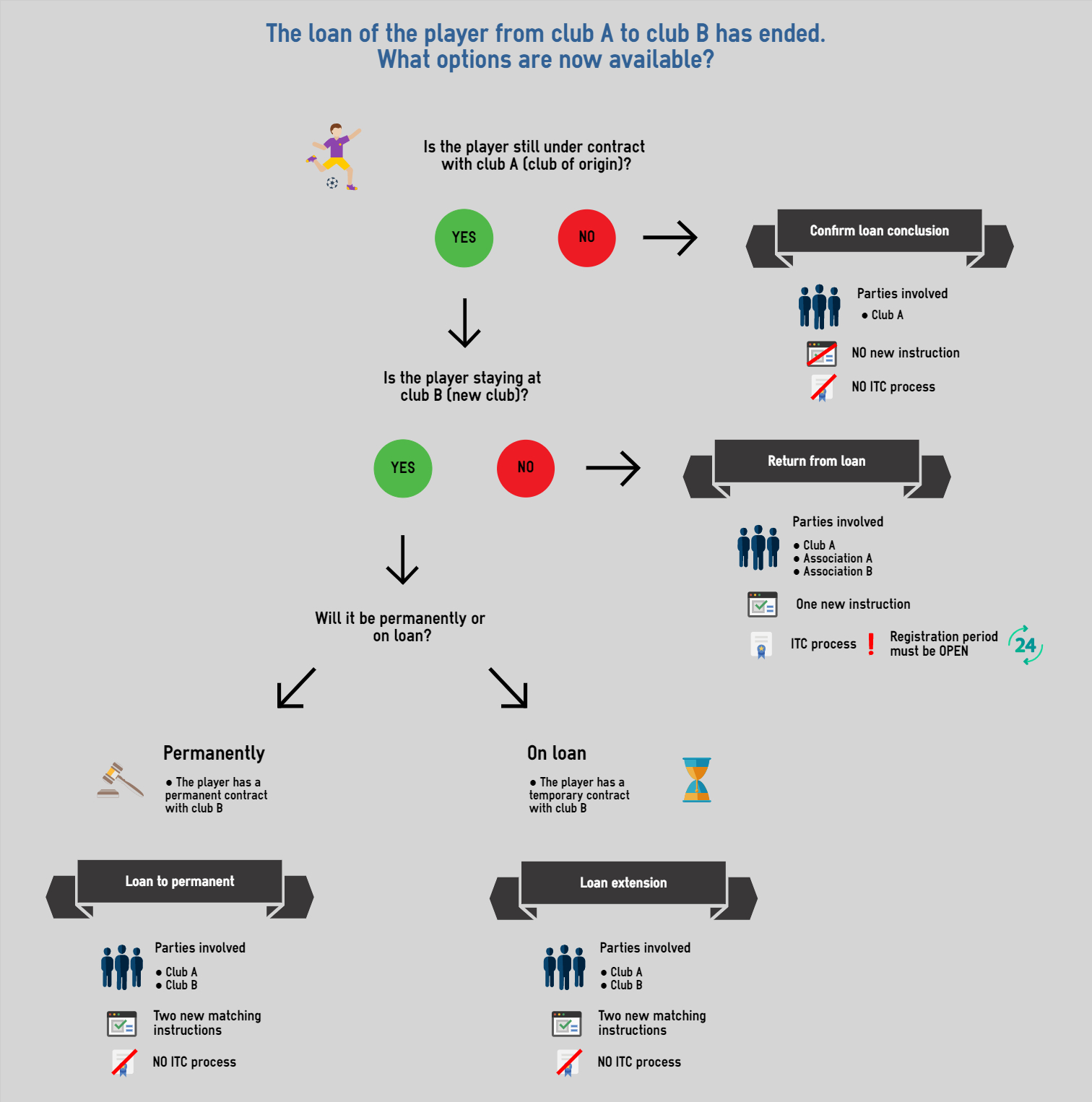
Once the loan period has ended (this includes situations where the loan has been terminated early), the necessary action must be taken in TMS to reflect the player’s next move. This should be performed by the club that released the player on loan (club A) and/or the club where the player is on loan (club B), depending on the situation.
The two clubs should speak to each other to make sure that the necessary steps are correctly taken in TMS without delay so that they can both benefit from an additional loan within the cap.
The options available at the end of the loan are:
Return from loan:
if the player is to return to club A, the latter must process a “Return from loan”. Club B does not need to do anything in TMS (see “Return from loan”). Once the return from loan is closed in TMS, the ITC will be back with club/Member Association A.
Note: the ITC in a “Return from loan” can only be requested during an open registration period. If an ITC request in a “Return from loan” is made when the new association’s registration period is closed, the transfer will trigger a “validation exception” (see “Validation issues”). When a “return from loan” is entered, the original loan ceases to count for the cap.
Loan extension:
if the two clubs have agreed to extend the term of the loan, one club must process the “Loan extension” instruction and the other club must enter the corresponding “Loan extension” counter instruction. Both clubs must match the two instructions in TMS. Since the ITC of the player is already with Member Association B, there is no ITC process (see “Loan extension”).
To create the matching “Loan extension” instruction, the counter club will need to enter the counter instruction from the dashboard notification directly. The notification will stay until a matching counter instruction has been confirmed and matched (for a maximum of six months).
Note: loan extensions are also included in the general loan cap and the club‑to‑club loan cap. This means that if a loan is extended, it will continue to count for the cap.
Loan to permanent:
if the two clubs have agreed that the player will remain at club B on a permanent basis, one club must process the “Loan to permanent” instruction and the other club must enter the corresponding “Loan to permanent” counter instruction. Both clubs must match the two instructions in TMS. Since the ITC of the player is already with Member Association B, there is no ITC process (see “Loan to permanent”). When a “loan to permanent” is entered, the original loan ceases to count for the cap.
To create the matching “Loan to permanent” instruction, the counter club will need to enter the counter instruction from the dashboard notification directly. The notification will stay until a matching counter instruction has been confirmed and matched (for a maximum of six months).
Confirm conclusion of loan:
club A can “confirm the conclusion of the loan” only if
(a) the loan has ended, and
(b) the employment contract between club A and the player has ended, and
(c) the player is not returning to club A.
Club B does not need to do anything in TMS in such a situation. By confirming the loan conclusion in TMS, the original loan will enter “Closed” status. As a consequence, it will no longer be possible to process a “Return from loan”, “Loan extension” or “Loan to permanent” instruction. Accordingly, club A must take great care when confirming the conclusion of a loan (see “Confirm conclusion of loan”). If your club has confirmed the loan conclusion by mistake, contact the TMS Helpdesk for further assistance.
Note: once the clubs have chosen one of the options available above, the original loan will change to status “Closed” or “Closed – awaiting payments”. With the exception of the return from loan, in all other cases, the player’s ITC and registration will remain with Member Association B.
The overview below summarises the four options available at the end of the loan: