Table of contents
Introduction
This instruction type applies to players who will be transferred on loan, either domestically or internationally.
“International transfers: scope” provides an overview of the transfer instruction types. Review the details of the transfer to ensure that you select the correct instruction type before proceeding in TMS.
The loan agreement information must be entered as accurately as possible, and the mandatory documents must be uploaded by both clubs. For more information on the mandatory documents, see “Transfer documents in TMS: mandatory documents, upload rules and evidence”. The information provided by both clubs must match for the transfer to proceed to the next stage. For more information on this topic, see the “Matching process and matching exception” section.
Note: clubs must respect the general loan cap and the club-to-club cap, which were established and came into force on 1 July 2022 for international loans. Those loans that exceed the cap will be blocked in TMS by a validation exception, and the parties must take the necessary steps in the platform to resolve this. Furthermore, at the end of the loan, the clubs involved must finalise the loan to reflect the player’s next move. For more information on this topic, see “Loans: scope”.
Creating the instruction
To enter an instruction to release a player on loan, navigate to the “Transfers > Overview” tab, click on “Release player” and select “On loan” under either the International or Domestic categories.
“Players & Clubs” section
Player
The details of the player involved in the transfer must be disclosed. To do this, search for the player you wish to release by entering their name, nationality, date of birth and/or player ID. If the player is in the TMS database, their name appears in the drop-down list.
If the player is not in the TMS database, you can expand the search across Connect ID, which includes player records from the National Registration System (NRS) of all Member Associations. For more information on how to search for, create and edit players, see the section “Searching for, creating and editing players”.
If you create a new player, the former association must first confirm their identity details before the transfer can proceed. For more information on this topic, see the section “Player confirmation”.
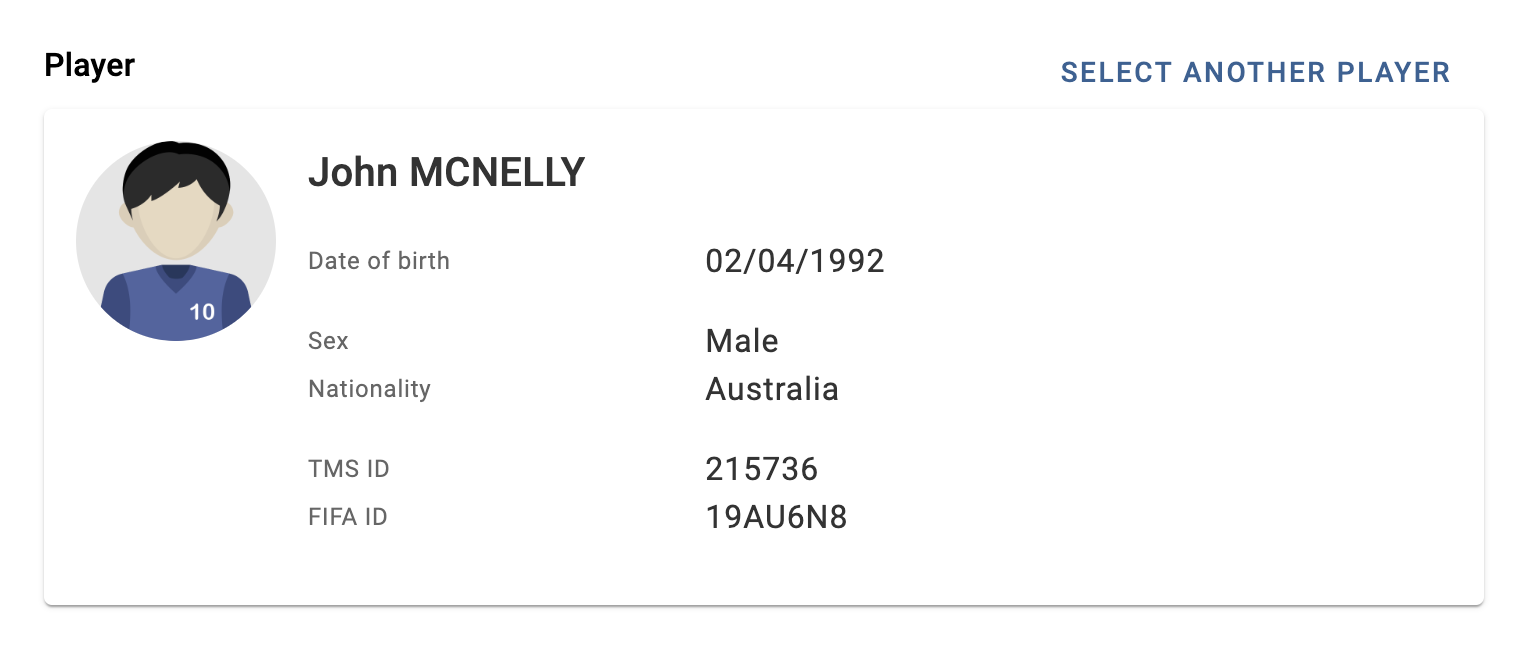
Once you have selected the player, their details appear in the “Player” section.
New club
The counter club involved in the transfer agreement must be selected by typing its name in the relevant field. Ensure that the correct counter club is selected.
If you are sure that it cannot be found and is not listed in TMS, contact the relevant Member Association; the club will need to be trained and given access to TMS before completing the transfer.
Former club
As you are releasing the player, your club will automatically be selected as the player’s former club.
Enter the player’s employment contract dates with the former club by using the calendar search or by typing the date manually. Enter the loan agreement dates by using the calendar search or by typing the date manually. The loan end date must not be later than the end date of the current employment contract. For international loan transfers, the loan duration may not exceed one year.
Carefully select an end-of-loan date within the registration period of the former association (the association of the original club of the player). For domestic loan transfers, the end-of-loan date must be within your Member Association’s established registration period. If, upon entering the “Return from loan” instruction, the registration period of that association is closed, the transfer will be blocked by means of a validation exception. For more information on how to process the transfer at the end of the loan, see “Loans: scope”.
The loan agreement must also be uploaded by clicking on “Drop files to attach or click to browse”.
As loan cap provisions apply to international loan transfers, an additional question on the player's loan cap exemption status will appear if the player is under 22 years of age and is subject to an international loan transfer. Details on the loan cap exemption criteria and applicable requirements are provided below. For domestic loan transfers, no additional information is required in this section.
Note: a club-trained player is a player who, between the age of 15 (or the start of the season during which they turn 15) and 21 (or the end of the season during which they turn 21), and irrespective of nationality and age, was registered with their current club for three complete seasons or 36 months, whether continuously or not.
If the club selects “Yes”, it will need to upload proof that the player is club-trained and moving before the end of the season when the player turns 21.
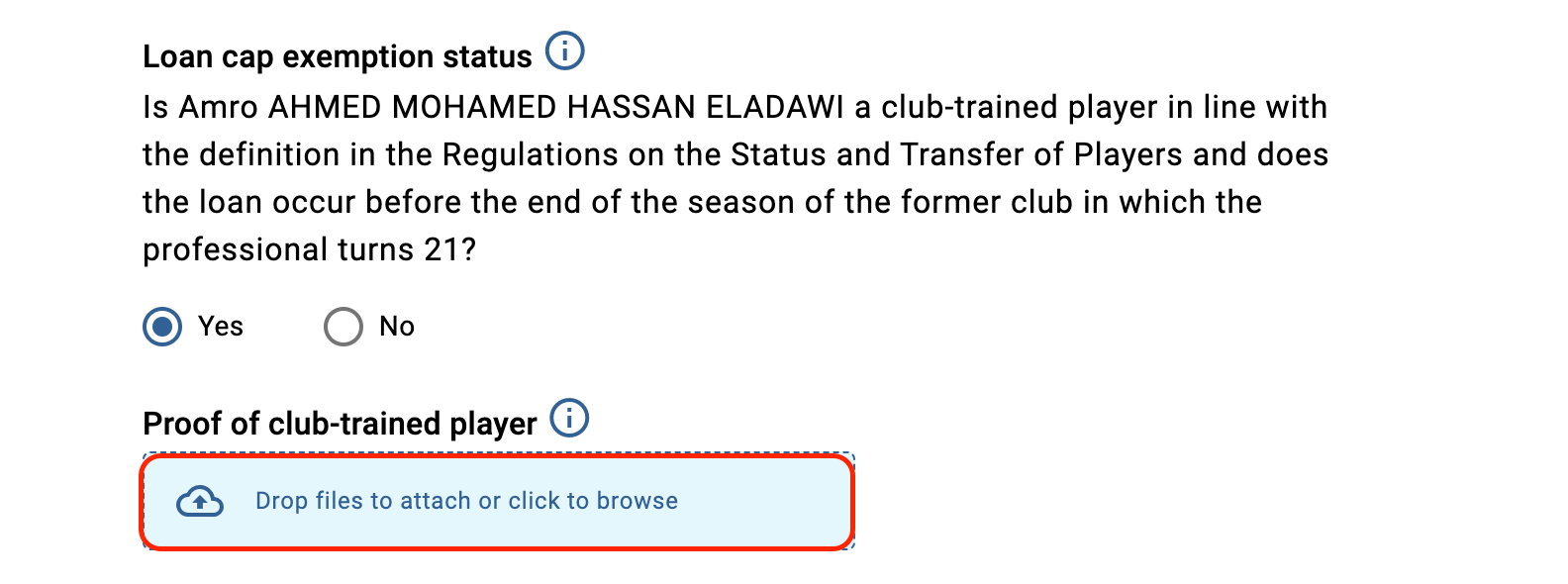
If the club selects “No”, no further action is needed.
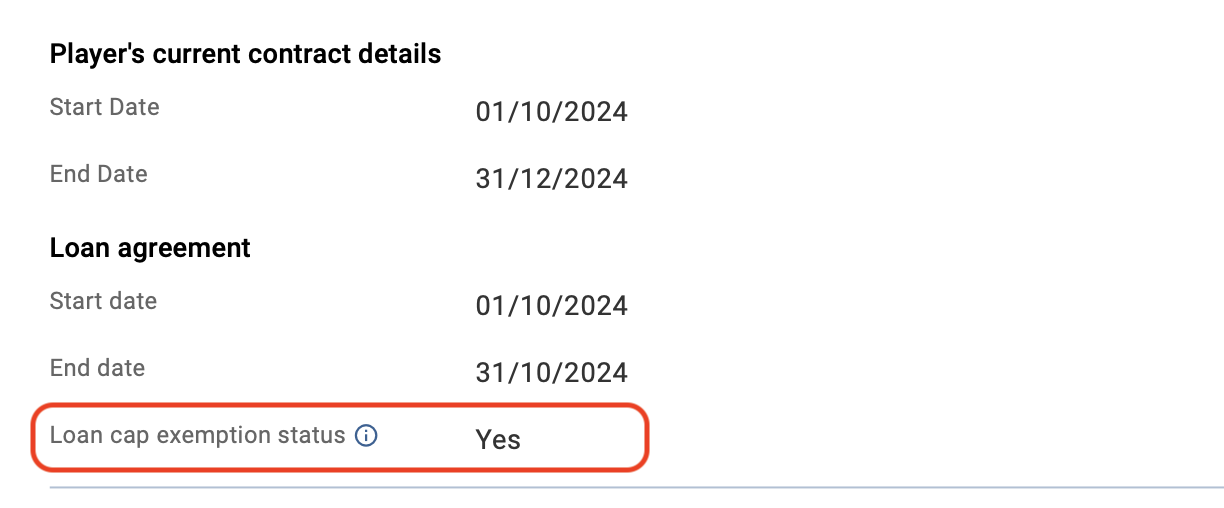
As soon as the transfer is saved, TMS will indicate whether the instruction is considered as exempt from the loan cap based on the exception in art. 10 par. 7 of the FIFA Regulations on the Status and Transfer of Players.
“Football Agents” section
If your club has an agent representing it in relation to this transfer, this information must be entered in TMS by clicking “Yes”. You will then be required to declare the agent information within the transfer. For more information, see “Declaring agent information”.
“Payments & TPO” section
If the transfer includes any fixed transfer fee, conditional transfer fee and/or sell-on fee payments, select “Yes” to the payment question under the “Payments & TPO” tab. If it does not, select “No”.
If you click “Yes”, enter the payment details accordingly, i.e. the currency in which the payment will be made, the payment amount, details of instalments (if any), and your club’s banking details. For more information on how to declare the payments within a transfer instruction, see the section “Club-to-club payments within the transfer instruction”.
For additional information on declaring transfer compensation and related training rewards, see the clarifications communicated by the FIFA Clearing House on 30 January 2023.
Declaration on third-party payments and influence on clubs
Prior to confirming the transfer, you must, on behalf of your club, either declare “Yes” or “No” to the declaration on third-party influence on clubs. For more information on this topic, see the section “Third-party influence”.
Failure to provide mandatory information or entering incorrect information in ITMS is an offence subject to the Administrative Sanction Procedure (ASP).
Declaration on third-party ownership of player’s economic rights
Prior to confirming the transfer, you must, on behalf of your club, either declare “Yes” or “No” to the declaration on third-party ownership (TPO) of a player’s economic rights.
If you tick “Yes” under the declaration on TPO, you must enter the third party and payment details as well as upload the TPO agreement.
For more information on this topic, see the section “Third-party ownership”.
Confirmation
Once you have entered all the necessary details in the instruction and have uploaded all the mandatory documents, you may either confirm the transfer or save it as a draft and return later. If you choose to save as draft, the status of the transfer will change to “Pending” until it is confirmed.
Certify that all the information is true and correct by clicking on the relevant box, and once you are certain that everything is in order, click on “Confirm transfer”.
Once you have confirmed the instruction, the transfer status will change to “Awaiting counter instruction”.
If the counter club has already entered a matching instruction, the status of the transfer will be either “Awaiting confirmation of player”, “Awaiting ITC request” for international transfers, or “Awaiting transfer approval” for domestic transfers.
If the transfer remains in status “Awaiting counter instruction” or if the transfer changes status to “Matching exception”, contact the counter club to resolve the mismatch. For more information on this topic, see the section “Matching process and matching exception”.