TABLE OF CONTENTS
- International transfers
- What is an international transfer?
- What is the difference between a professional player, an amateur player, and a minor player?
- When should an international transfer be entered into TMS?
- What transfer instruction types can be submitted in TMS?
- How do I determine the correct instruction type for an international transfer?
- How do I enter a transfer in TMS?
- Domestic transfers
International transfers
International transfers of refugees and protected persons, i.e. of those players moving internationally for humanitarian reasons, follow a special procedure. For more information on this topic, see “International transfers of refugees and protected persons: scope”.
What is an international transfer?
For the purposes of the transfer matching system, an international transfer is the movement of the registration of a player from one association to another association (cf. definition no. 21 of the Regulations). International transfers must be entered into the International Transfer Matching System (ITMS), a mandatory system for the international transfer of male and female amateur and professional players in 11-a-side football.
What is the difference between a professional player, an amateur player, and a minor player?
Professional player
A player is considered a professional if they meet the two requirements below (cf. art. 2 par. 2 of the Regulations on the Status and Transfer of Players):
- have a written contract with a club; and
- are paid more for their footballing activity than the expenses they incur.
Overall, it is the remuneration that is set out in a player’s written contract that will determine whether the player is considered a professional. It is irrelevant whether the contract is called, for example, an “amateur contract” or a “scholarship agreement”, etc., or if the player is registering with an “amateur club”, as the status of the club does not determine the player’s status.
Amateur player
An amateur is a player who does not have a written contract and/or who is not paid more for their footballing activity than the expenses they incur. An amateur is a player who essentially pursues footballing activity as a hobby. Expenses incurred through involvement in a match or in training (e.g. travel and hotel costs, insurance, etc.) and the costs of a player’s equipment can be reimbursed to the player without affecting their status as an amateur.
Minor player
A minor is a player who has not yet reached the age of 18. International transfers of players are only permitted if the player is over the age of 18, though there are five exceptions to this rule that are outlined in art. 7 of the RSTP.
International transfers of minor players and first registrations of non-national minor players are subject to the prior approval of the Players’ Status Chamber, unless the new association has been relieved of its obligation to make a formal application for approval by means of the limited exemption (see “Minors: scope” and “Minor players and academies”).
When should an international transfer be entered into TMS?
The international transfer of any player, amateur or professional, must be entered in the Transfers > Overview tab of TMS during the new association’s relevant registration period.
If the player is being registered as a professional with their new association, TMS should be used as soon as the relevant transfer or loan agreement has been concluded between the new club and the former club or, where no transfer or loan agreement exists, after the player’s employment contract has been concluded between the new club and the player.
Note: TMS must not be used for contractual negotiations.
What transfer instruction types can be submitted in TMS?
Professional
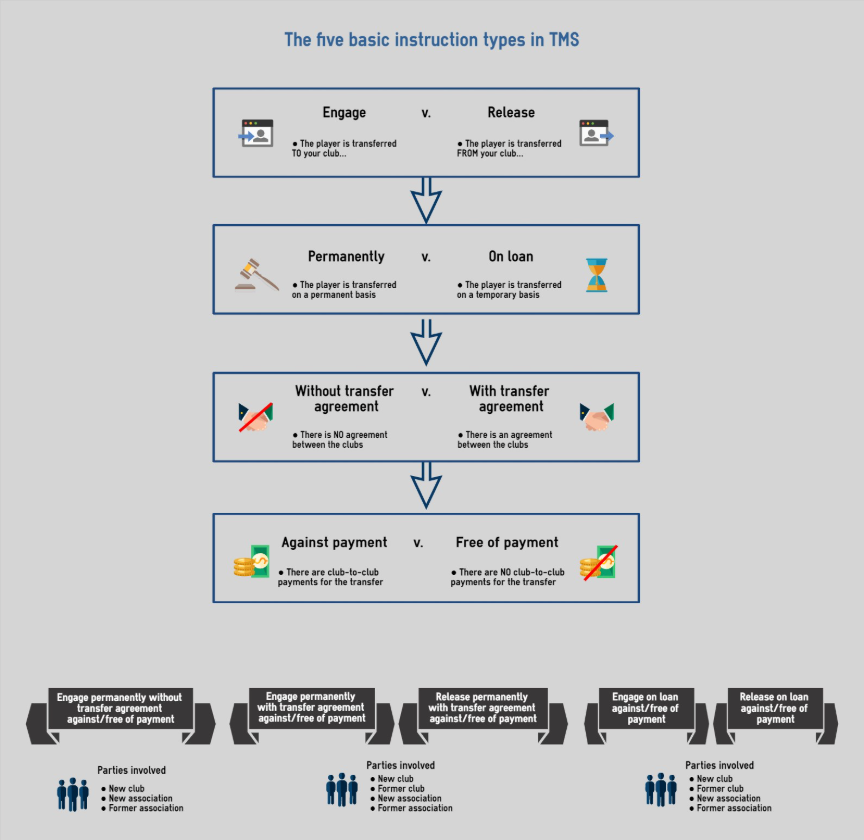
If the player is being registered at the new association as a professional, there are five basic instruction types:
- Engage permanently without transfer agreement against/free of payment
- Engage permanently with transfer agreement against/free of payment
- Release permanently with a transfer agreement against payment or free of payment (“Release permanently”)
- Engage on loan against/free of payment
- Release on loan against/free of payment
Amateur
If the player will be registered with the new association as an amateur, there is one basic instruction type:
- Engage permanently without transfer agreement free of payment
How do I determine the correct instruction type for an international transfer?
Below is a road map to help you find the correct basic instruction type:
How do I enter a transfer in TMS?
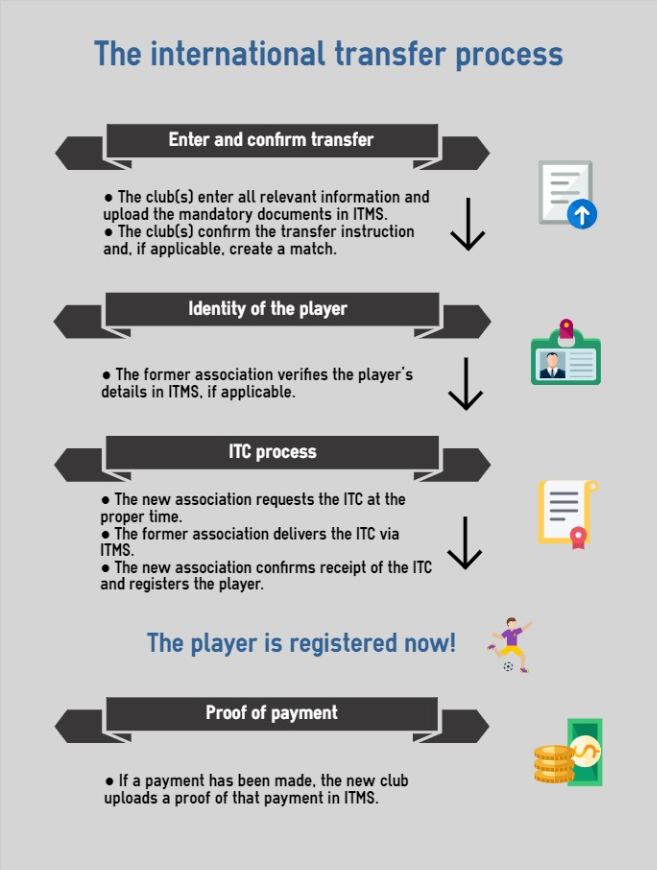
The international transfer process for professional and amateur male and female 11-a-side football players in accordance with Annexe 3 of the Regulations can be summarised as follows (see “International transfers: scope”):
Domestic transfers
Member Associations are required to record domestic transfers in their National Registration System (NRS). The Domestic Transfer Matching System (DTMS) is the national version of the International Transfer Matching System (ITMS) and may be adopted by a Member Association as its NRS.
Regardless of the domestic transfer system used, it is essential that domestic transfer data is communicated to TMS. This enables the possible trigger of EPPs and ensures the correct processing of training rewards.
If your Member Association uses a registration system other than DTMS, any domestic transfer of a player where transfer fees exist (“domestic transfer declaration” or “DTD”) and any first registration of a player as a professional (“FPR”) are automatically notified to TMS from the Member Associations’ electronic NRS and their domestic transfer system. For more information on DTDs and FPRs, see the “Scope of domestic transfers and first registrations as a professional”.
With DTMS, the Member Association and its clubs have the ability to manage and monitor their domestic transfer activity, generate statistics and reports, speed up the transfer process and store required documents online, safely. With this extension of TMS, the system allows the Member Association to access international and domestic transfers in one place.
DTMS and ITMS are fully integrated and operate very similarly. There are, however, some differences between the two systems:
Regulations
DTMS is exclusively governed by the domestic regulations of the specific Member Association that has adopted it. Therefore, the regulating body is the Member Association.
ITMS, on the other hand, is governed by FIFA. All international transfers must adhere to the FIFA Regulations on the Status and Transfer of Players (RSTP).
DTMS is not mandatory; any Member Association may choose to adopt it. ITMS, on the other hand, is a mandatory system for the international transfer of male and female amateur and professional players in 11-a-side football.
Process
DTMS only requires the intervention of the Member Association. First, it approves the transfer and then confirms the player’s registration to complete the transfer.
ITMS, on the other hand, requires the new association to request the international transfer certificate (ITC) and the former association to deliver the ITC, therefore two associations are always involved.
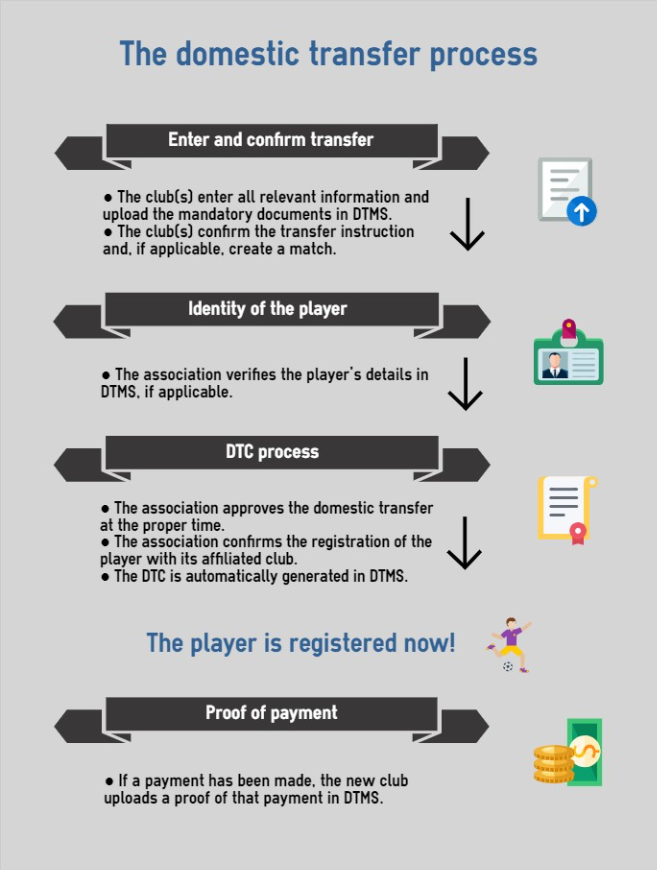
The overview below summarises the domestic transfer process in DTMS.