Table of contents
Introduction
Training rewards, namely training compensation and the solidarity mechanism, compensate training clubs for their role in the training and education of young players who become professionals. These mechanisms encourage clubs to invest in youth development and promote a spirit of solidarity between the elite and grassroots football.
To help ensure that clubs receive their fair share for training and educating players, the FIFA Council approved the FIFA Clearing House Regulations in October 2022. The Regulations entered into force on 16 November 2022. The FIFA Clearing House focuses on the centralisation, processing and automation of payments between clubs relating to training compensation and the solidarity contribution, as well as on the promotion of financial transparency and integrity within the international transfer system.
Overview of the Clearing House process
Under the FIFA Clearing House project, TMS automatically identifies potential triggers for the entitlement to training rewards and creates a provisional electronic player passport (EPP) for the relevant player in the following scenarios:
- First registration of a player as a professional
- International transfer of a professional player
- National transfer of a professional player against transfer compensation and with an international dimension identified
To get an idea of the training rewards that clubs may be entitled to or obliged to pay as a result of these trigger events, clubs may use the Training Rewards Calculator, a practical, intuitive and user-friendly tool. The calculation is an estimate and may not represent the final amounts due. Those amounts can be determined only after the trigger event is identified, the EPP is generated in TMS and the EPP process is completed.
The EPP is an electronic document containing the registration history of a player throughout their career, including the relevant Member Associations, the player’s status (amateur or professional), the registration type (permanent or loan) and the clubs, including their training categories, with which the player has been registered from the calendar year of their 12th birthday.
To populate the EPP, player registration information is communicated automatically to TMS from Member Associations’ electronic National Registration Systems, via the FIFA Connect ID integration. To this end, Member Associations are required to ensure that:
- all players, whether male or female, amateur or professional, are registered with a FIFA ID;
- a unique FIFA ID is assigned to a player throughout their career as an amateur and professional;
- all affiliated clubs are registered with a FIFA ID;
- all player registrations and domestic transfers are kept up to date and are duly processed using NRSs that are integrated with FIFA Connect ID or TMS; and
- all international transfers are processed in TMS.
If it is determined that training rewards are due, an allocation statement is automatically calculated by TMS, if applicable, based on the player registration in the final EPP, which includes the amount(s) to be distributed to training clubs. For allocation statements generated on or after 1 January 2026, entitlements to training rewards of less than EUR 100 (or the equivalent in another currency) will be discarded and will not be included in the allocation statement.
An overview of the electronic player passport process is presented below:
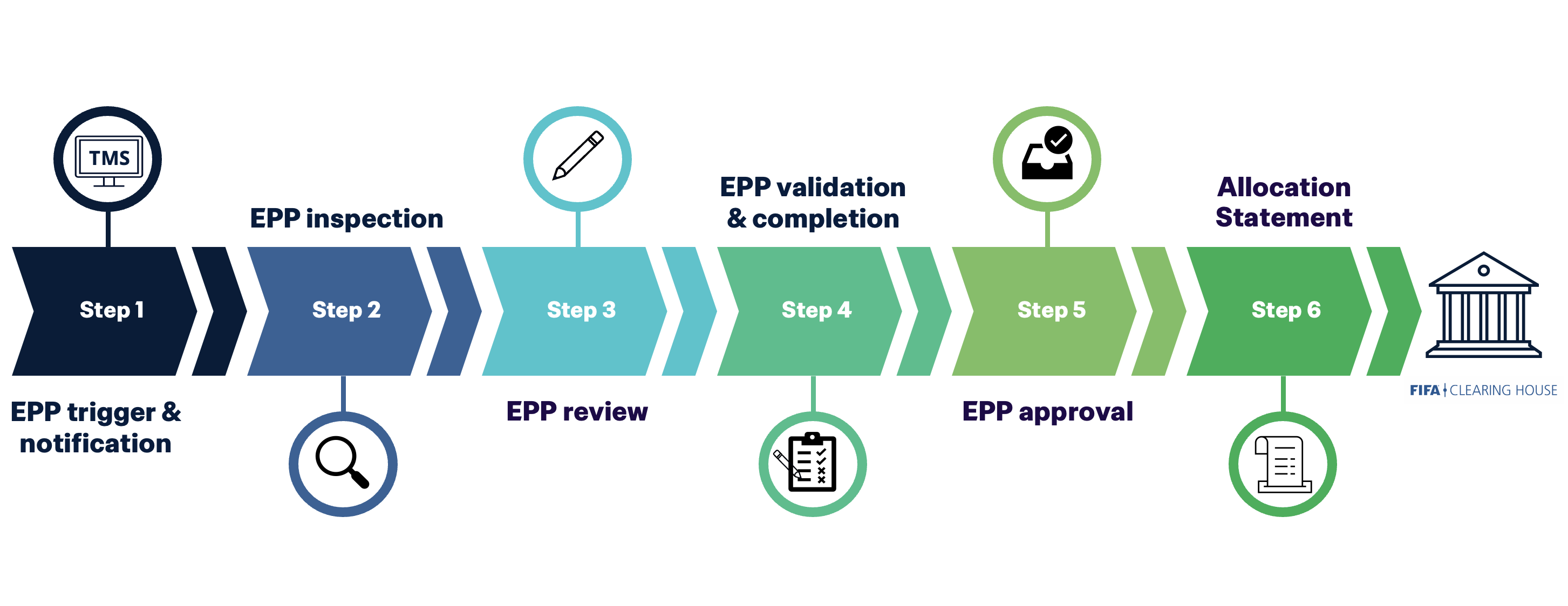
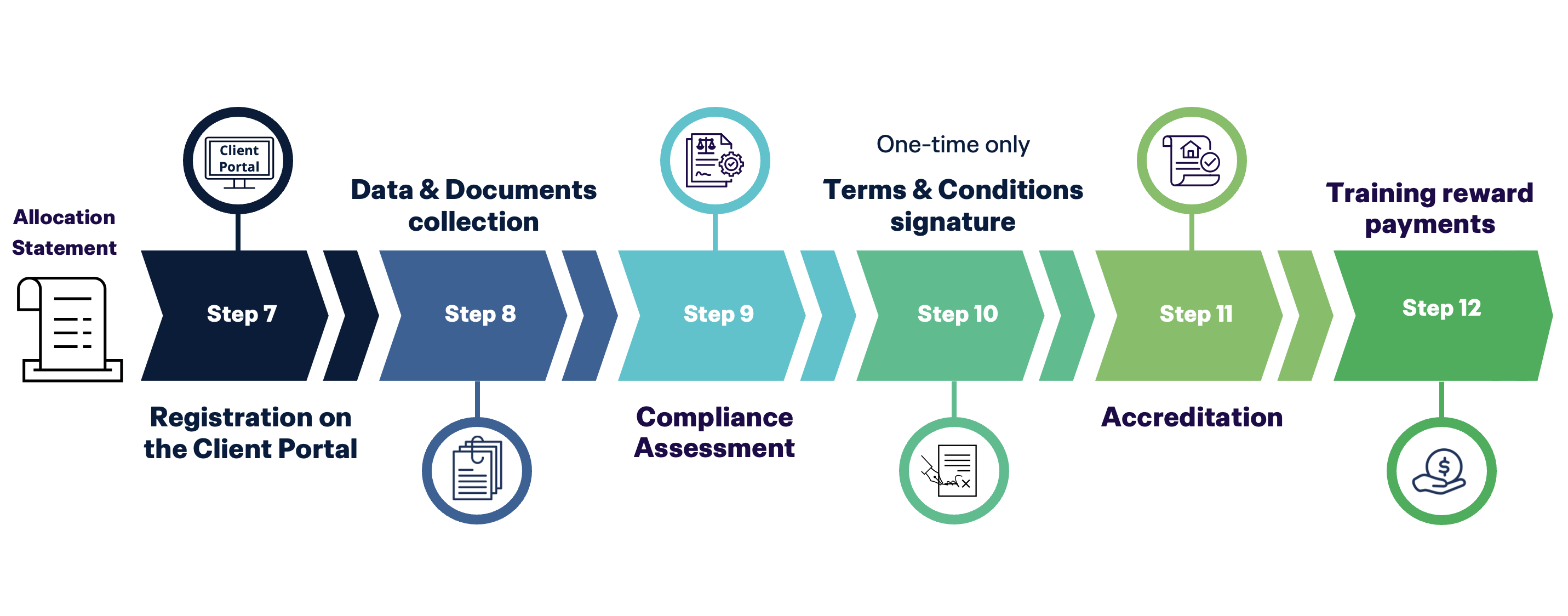
Collection and distribution of the relevant amounts based on the allocation statement are carried out by the independent FIFA Clearing House entity after the paying and receiving parties have successfully passed the compliance assessment.
To ensure the timely distribution of training rewards, clubs and Member Associations are required to comply with requests from the FIFA Clearing House (FCH) and complete all mandatory steps of the Clearing House process within the established deadlines. Failure to do so will result in the escalation of the Non-Compliant Party by the FCH to the FIFA administration for review.
An overview of the compliance assessment and payment distribution process is presented below:
The impact of the FIFA Clearing House
Three years in, the impact of the FIFA Clearing House across the football world is clear: more than USD 500 million in training rewards have been allocated by the FIFA administration for distribution with over USD 380 million – around three quarters of that amount – already paid out via the FCH to develop future talent and support football infrastructure. This corresponds to over 7,000 clubs receiving vital financial support to promote player and club development.
For more information on the initiative and the results from the FIFA Clearing House’s first 24 months of operation, see the FIFA Clearing House report published in November 2024.
Training rewards triggered before the FIFA Clearing House go-live
Training rewards derived from trigger events before 16 November 2022 are not subject to the FIFA Clearing House Regulations and the EPP process. Instead, the registering Member Association must provide the player’s club with a player passport containing all the relevant registration data since the calendar year of the player’s 12th birthday. This “traditional” player passport is manually completed and uploaded to TMS by a Member Association.
The new club is responsible for calculating and paying training compensation and/or the solidarity contribution to the training club(s) based on the most recent player passport which contains information from all the Member Associations with which that player has been registered during their career.
The new club must pay any training rewards due to the training club(s) no later than 30 days after the player’s registration or, in the case of the solidarity contribution, 30 days after the date of the execution of club-to-club payments.
In cases of dispute regarding training rewards derived from trigger events occurring before 16 November 2022, the traditional claims system still applies, under which parties must submit a claim for training compensation or the solidarity mechanism in TMS, in accordance with the Procedural Rules Governing the Football Tribunal. The Football Tribunal will not hear any case if more than two years have elapsed since the event that gave rise to the dispute.