Table of contents
Member Associations are required to record domestic transfers in their National Registration System (NRS). The Domestic Transfer Matching System (DTMS) is the national version of the International Transfer Matching System (ITMS) and may be adopted by a Member Association as its NRS.
Regardless of the domestic transfer system used, it is essential that domestic transfer data is communicated to TMS. This enables the possible trigger of EPPs and ensures the correct processing of training rewards.
If your Member Association uses a registration system other than DTMS, any domestic transfer of a player where transfer fees exist (“domestic transfer declaration” or “DTD”) and any first registration of a player as a professional (“FPR”) are automatically notified to TMS from the Member Associations’ electronic NRS and their domestic transfer system. For more information on DTDs and FPRs, see the “Scope of domestic transfers and first registrations as a professional”.
With DTMS, the Member Association and its clubs have the ability to manage and monitor their domestic transfer activity, generate statistics and reports, speed up the transfer process and store required documents online, safely. With this extension of TMS, the system allows the Member Association to access international and domestic transfers in one place.
DTMS and ITMS are fully integrated and operate very similarly. There are, however, some differences between the two systems:
Regulations
DTMS is exclusively governed by the domestic regulations of the specific Member Association that has adopted it. Therefore, the regulating body is the Member Association.
ITMS, on the other hand, is governed by FIFA. All international transfers must adhere to the FIFA Regulations on the Status and Transfer of Players (RSTP).
DTMS is not mandatory; any Member Association may choose to adopt it. ITMS, on the other hand, is a mandatory system for the international transfer of male and female amateur and professional players in 11-a-side football.
Process
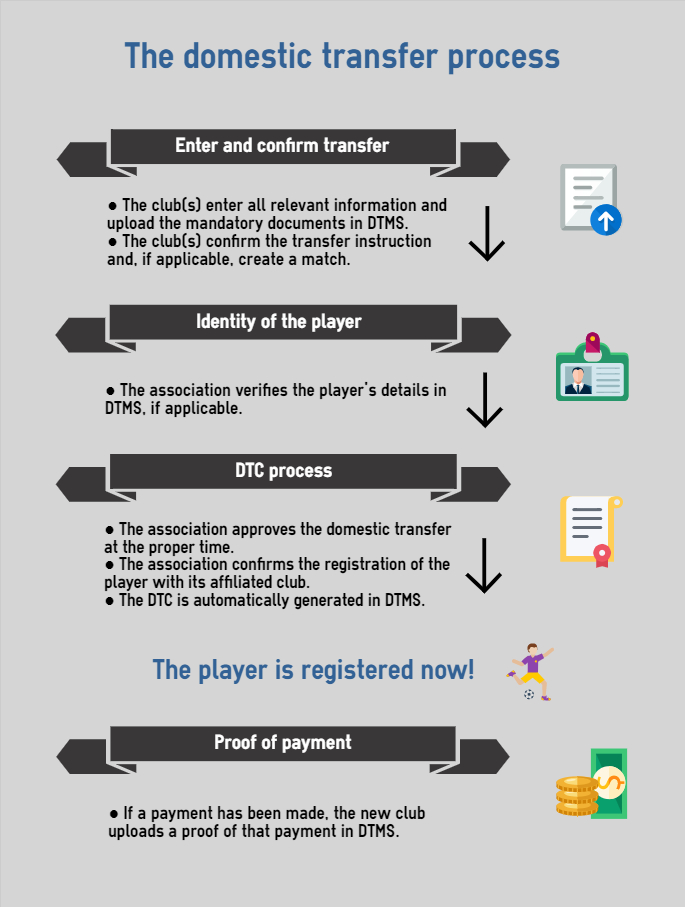
DTMS only requires the intervention of the Member Association. First, it approves the transfer and then confirms the player’s registration to complete the transfer.
ITMS, on the other hand, requires the new association to request the international transfer certificate (ITC) and the former association to deliver the ITC, therefore two associations are always involved.
The overview below summarises the domestic transfer process in DTMS.