Table of contents
Introduction
One of the main goals of TMS is to track financial payments made in connection with the transfer of professional players and thereby provide increased transparency concerning the cash flows in the market. To further this objective, clubs must indicate whether the transfer is being made against various payment types and upload evidence of the money transfer(s) in TMS. Proof of payment will typically consist of bank receipts confirming the details of the money transfer.
Stakeholders should also be aware that the proof of payment uploaded in the system is the only confirmation that can be accessed by all parties relevant to the transfer to determine if a payment that became due was made. Consequently, if a new club has made a payment but has not uploaded the corresponding proof of payment, the system will show this payment as outstanding and overdue.
Overdue payments
If a payment becomes overdue and has not been received as indicated in TMS, clubs are encouraged to contact the debtor club directly and, where appropriate, to submit a claim before the FIFA Football Tribunal (cf., art. 22 of the Regulations on the Status and Transfer of Players and art. 18 of the Procedural Rules Governing the Football Tribunal).
If there is a dispute between the two clubs regarding payments, submit an official letter to the FIFA Disputes & Regulatory Applications Department through the FIFA Legal Portal.
Club-to-club payment types
To avoid any discrepancies, it is recommended that clubs draft transfer agreements that clearly distinguish between the different payment types to be made.
Where a transfer agreement exists, clubs can insert three different payment types in the applicable fields when submitting a transfer. Only club-to-club payments must be disclosed in this section, not those referring to club-to-player or club-to-agent payments:
- Fixed transfer fee;
- Conditional transfer fee;
- Sell-on fee.
Clubs should observe the following when declaring payments where a transfer agreement exists:
- The total financial value of the transfer agreement (i.e. the amount paid by the new club) should be the sum of the three fields;
- The amount(s) declared in TMS should always reflect the amount(s) declared in the transfer agreement.
When entering a transfer for a player where no transfer agreement exists, clubs can insert one payment type:
- Release (buy-out) fee.
Note: for international transfers, failure to provide mandatory information or entering incorrect information in ITMS is an offence subject to the administrative sanction procedure (ASP).
Declaring payments in a transfer instruction
When entering a transfer in TMS, both clubs need to complete the “Payments & TPO” section correctly and accurately by completing all available mandatory yellow fields applicable to the instruction type.
Note: Member Associations and their clubs must declare the full amount of transfer compensation agreed between the clubs for the transfer of the player in the corresponding transfer instruction. The new club must then make these payments, withholding 5% of the total transfer compensation for solidarity contribution purposes unless agreed otherwise, and declare such payments accordingly. Once the applicable training rewards have been processed through the FIFA Clearing House, any remaining transfer compensation must be paid directly to the former club (See the section "Top-up payments").
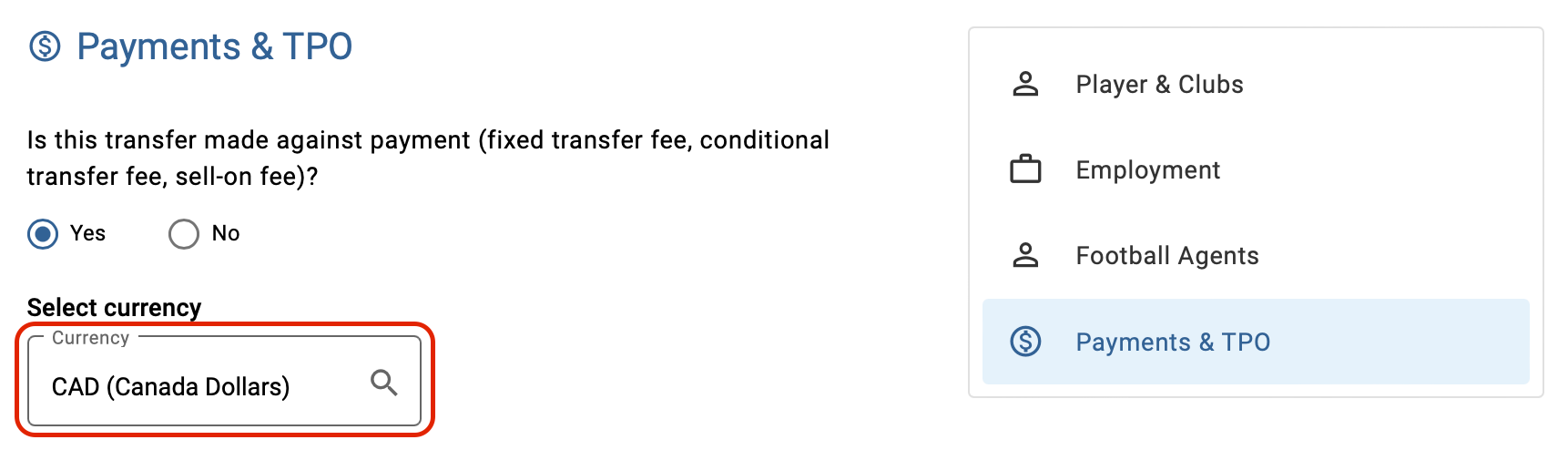
Start by entering the agreed currency.
Next, declare all agreed payments by entering the relevant details of the various payment types available.
The fields relating to fixed transfer fee, conditional transfer fee, and sell-on fee are mandatory matching fields; they cannot be blank, and the information entered by both clubs must match. If no payment is agreed for a particular payment type, both clubs need to enter “0” in the total and instalment amounts. The release (buy-out) fee is also a mandatory field, and if there is no amount to declare, the value “0” should be entered in the relevant field.
Note: any “option to buy” stipulated in a loan agreement should not be declared as a “conditional transfer fee” in the loan instruction, but rather as a “fixed transfer fee” in any subsequent loan-to-permanent instruction, if and when it applies.
If a particular payment type has been agreed (i.e. the amount is larger than “0”), the clubs will also need to specify the conditions of each agreed payment as follows:
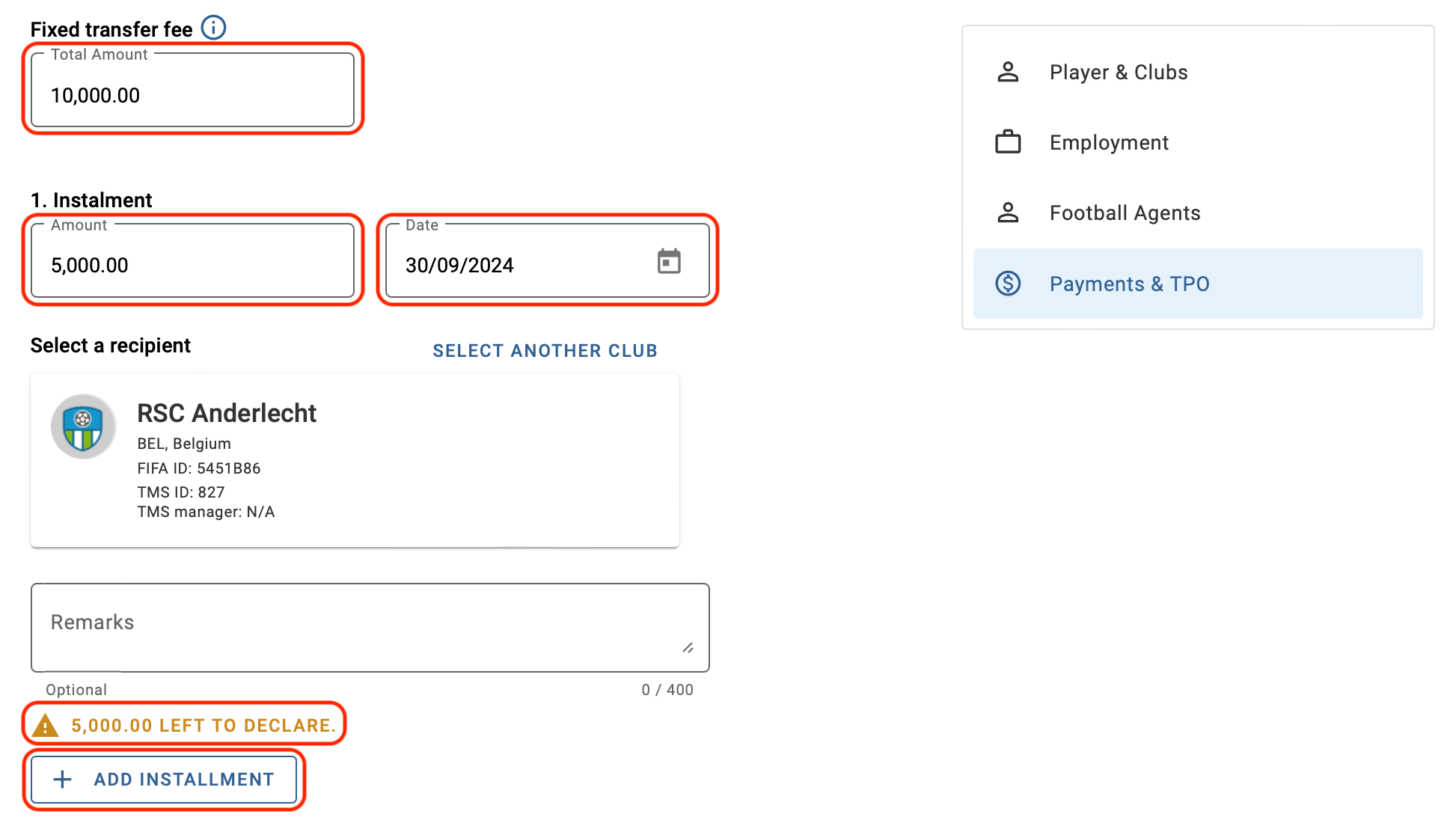
If the fixed transfer fee or release (buy-out) fee (for “engage out of contract” transfers) will be paid in multiple payments, you can add new instalments by clicking on “Add instalment”. You will then need to specify the agreed payment amount and date of the new instalment.
Technical note: For the release (buy-out) fee, if the “Total amount” field is equal to 0, enter “.0”.
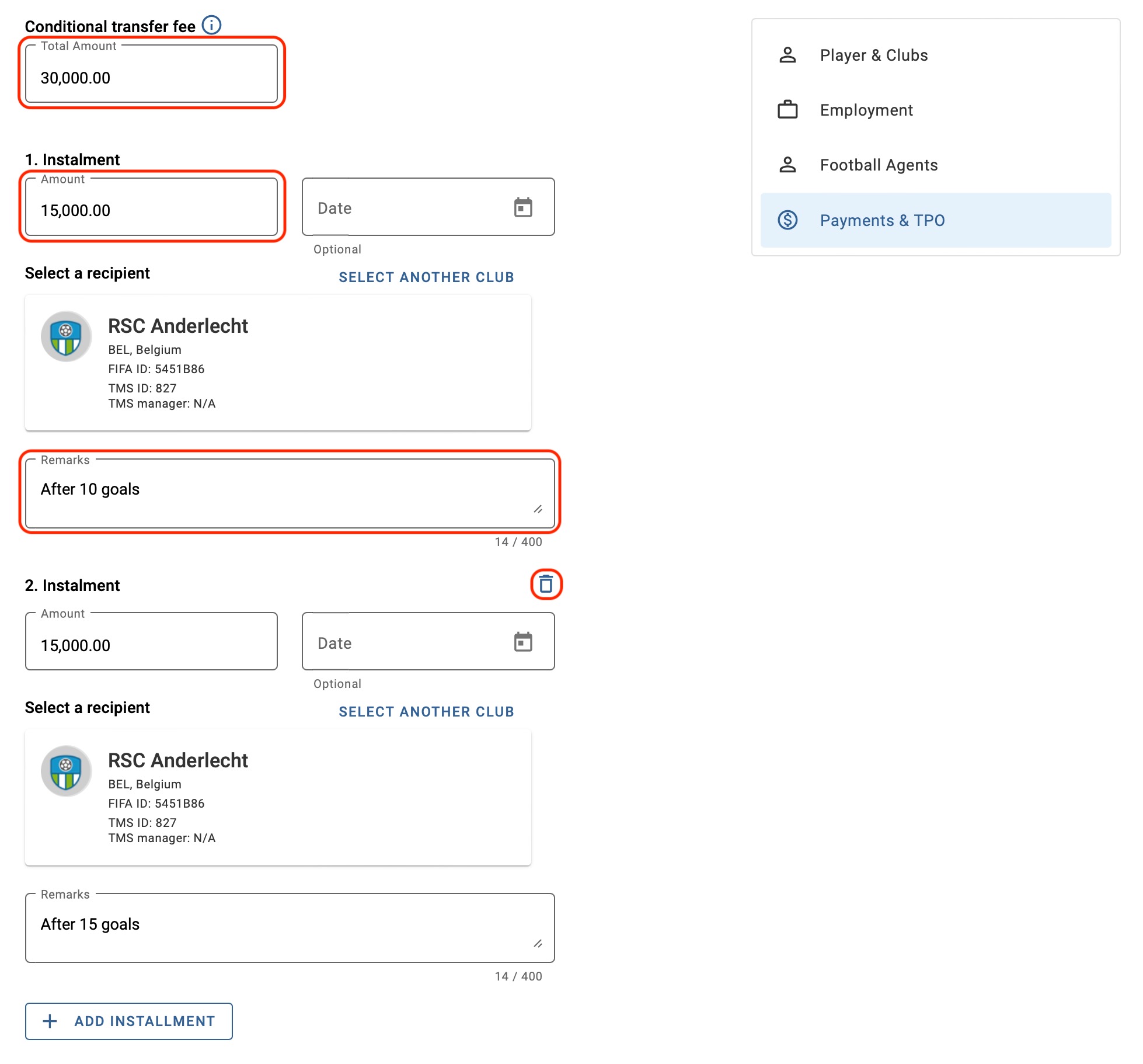
If the conditional transfer fee will be paid in multiple payments, you can also add new instalments by clicking on “Add instalment”. You will then need to enter the agreed payment amount and specify the conditions that will trigger the payment in the “Remarks” field (e.g. after scoring ten goals).
You can click on the trash icon to delete the instalment.
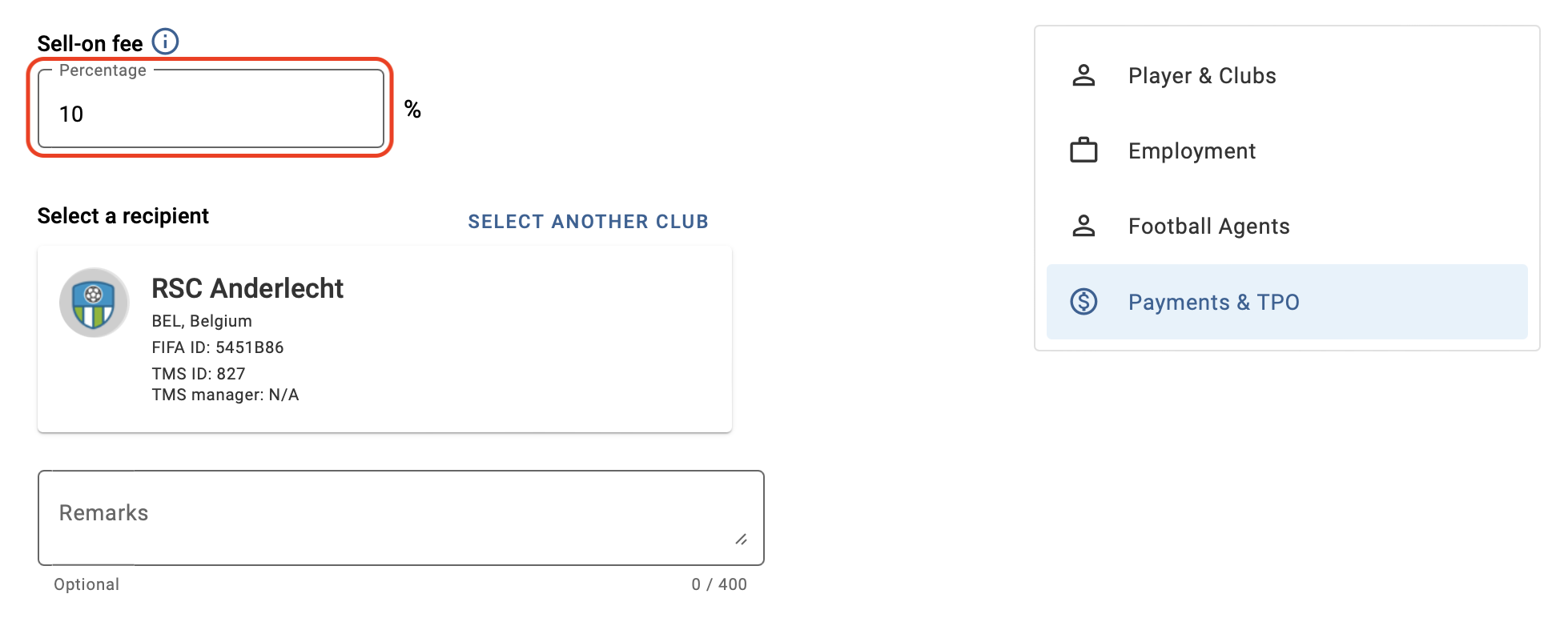
To declare a sell-on fee, enter the agreed percentage of the future transfer fee that will be paid in any subsequent transfer of this player to the player’s former club. For more information about sell-on fees, see the “Sell-on fee” section.
Finally, each club needs to enter its own bank details by selecting the appropriate option from the drop-down menu.
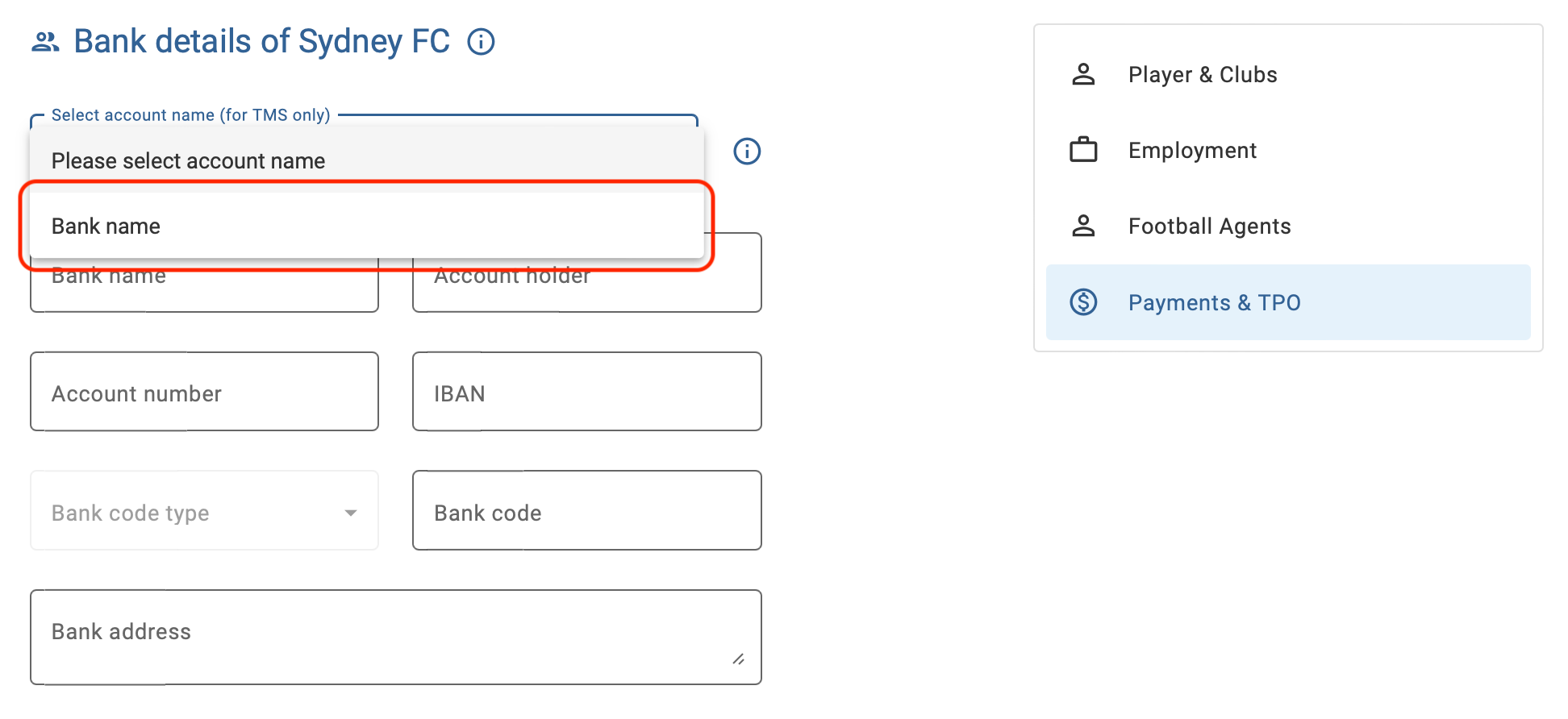
Note: bank details will only appear in the drop-down menu once this information has been added to your club’s details under the Stakeholders > Clubs tab. To update or add bank details in TMS, see the section “Editing club details”.